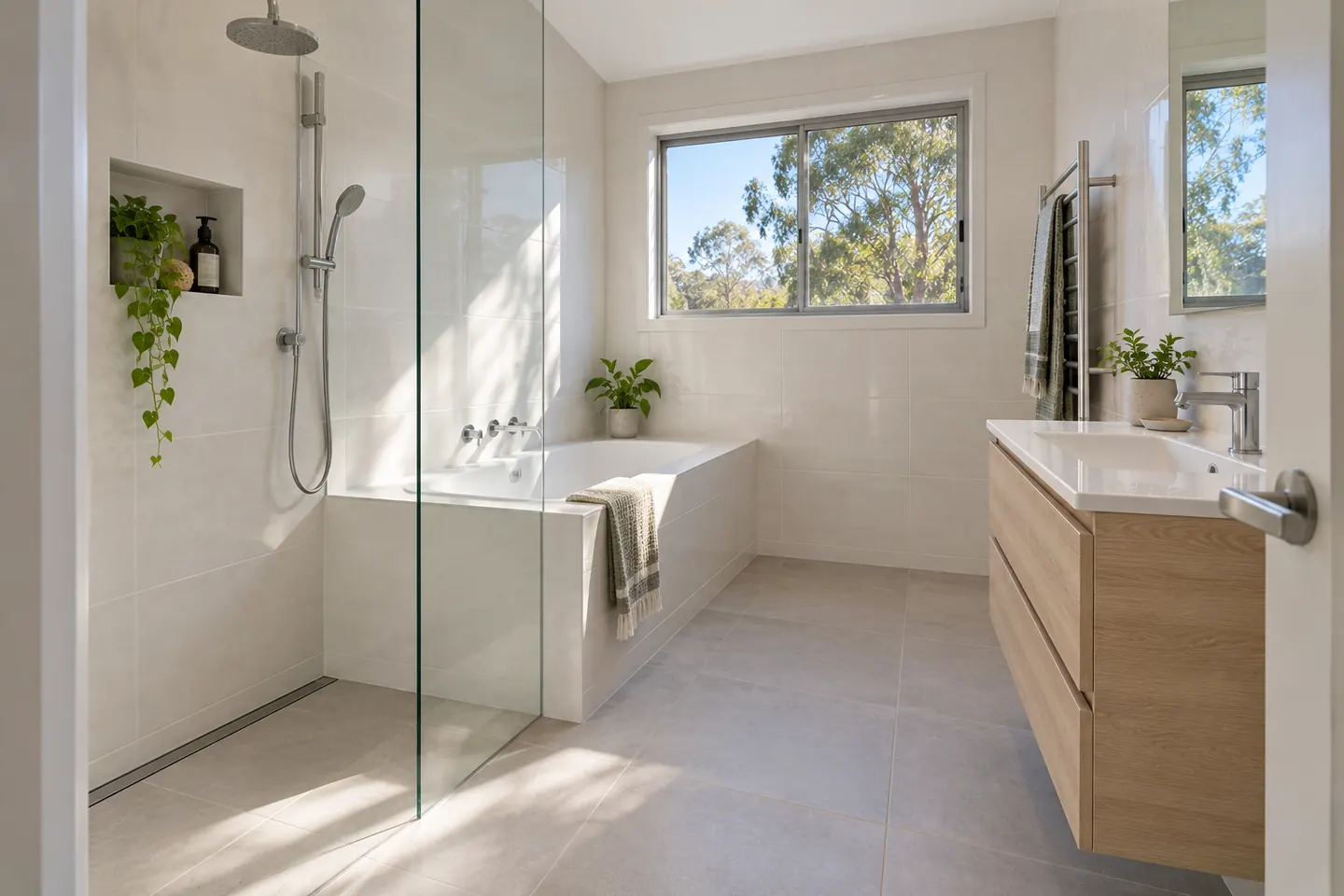
Established family streets
Jamisontown and South Penrith sit between the Penrith town centre and the Nepean River to the south. They were largely built out through the 1960s, 1970s and 1980s as affordable family housing, and much of that original housing is still here, some of it extended, much of it with the original bathroom.
The typical home is single-storey brick veneer on a slab, three or four bedrooms, a carport or garage, and a decent backyard.
The bathroom you probably have
In a 1960s–1980s Jamisontown or South Penrith home, the main bathroom typically has:
- A separate toilet in its own small room next door
- A built-in bath, often in a coloured or patterned tile surround
- A shower recess with a tiled hob and a framed sliding or pivot screen
- A vanity with doors, sometimes a laminate top with a basin set in
- Wall tiles to about 1.8 or 2 metres, with painted plasterboard above
- An exhaust fan that vents into the ceiling, or none at all
Some bathrooms had a refresh in the 1990s or 2000s — new vanity, new tiles over old — which can hide a failing membrane underneath.
Keep or combine the toilet?
This is the biggest layout decision in these homes.
Keeping it separate means someone can use the toilet while someone else showers. In a family house, that is a big deal in the morning. The toilet room can be renovated at the same time for relatively little.
Combining gives a noticeably bigger bathroom, room for a walk-in shower and a bath, and a single door off the hallway. The wall between the rooms is usually a non-loadbearing internal wall, but that is confirmed at the measure before it is quoted.
What gives the best value
In brick veneer homes on a slab, the value approach is simple:
- Keep the bath, shower and toilet waste positions where they are
- Remove the hob and create a walk-in shower with a fixed panel
- Tile walls to the ceiling
- Replace the vanity with a wall-hung drawer unit
- Fit a ducted exhaust fan and good lighting at the mirror
- Waterproof the whole floor and shower to the standard
That combination removes almost everything that dates the room, without paying to cut concrete.
Heat and the western sun
Many homes here have the bathroom on an outside wall under a tiled roof with little insulation. On hot summer afternoons, the room holds heat. Good ventilation, lighter tiles and a window that opens make a real difference, and if the ceiling is open during the renovation, adding insulation above the bathroom is worth asking about.
Asbestos
Homes built or renovated before 1990 are tested before demolition. Common materials include wet-area wall sheeting behind tiles, eaves and old vinyl under floor tiles. Removal, if needed, is done by a licensed asbestos removalist and priced as a separate line.
Near the river
Parts of Jamisontown and South Penrith are low-lying and close to the Nepean. Flood planning does not usually affect an internal bathroom renovation, but if a job involves an extension or a change to floor levels, it is worth checking what Penrith City Council's flood planning controls say for your lot.
Cost and program
As a 2026 guide:
- Main bathroom renovated in place: $20,000 – $30,000
- Bathroom and separate toilet combined: $26,000 – $36,000
- Separate toilet renovated alongside the bathroom: adds about $4,000 – $7,000
About three to four weeks on site. See the cost page.
Nearby
Penrith, Glenmore Park, Kingswood, Emu Plains and St Marys, plus Regentville and Leonay.
Renovation work is carried out in partnership with Coastal Renovation Group, a licensed NSW builder; licence and insurance details are provided on request. Call 02 4703 9332 or send the room details through.
Nearby suburbs
Questions people ask before they commit
What bathrooms are typical in Jamisontown and South Penrith?
A main bathroom off the hallway in a single-storey brick veneer home, usually with a separate toilet next door, a built-in bath, a shower recess with a hob, and tiles from the 1970s or 1980s. Later homes may have a small ensuite as well.
Should I combine the separate toilet with the bathroom?
It depends on the household. For a family, a separate toilet is very practical and worth keeping. For a couple or a smaller household, combining the rooms gives a larger bathroom. The wall between them should be checked before deciding.
Is asbestos likely in these homes?
It is possible in homes built or renovated before 1990. Wet-area sheeting, eaves and old floor coverings are common places. Testing before demolition is standard, and removal is by a licensed asbestos removalist.
What does a Jamisontown bathroom renovation cost?
As a 2026 guide, $20,000 to $30,000 for a typical main bathroom renovated in place, and $26,000 to $36,000 where the separate toilet is combined into a larger bathroom.