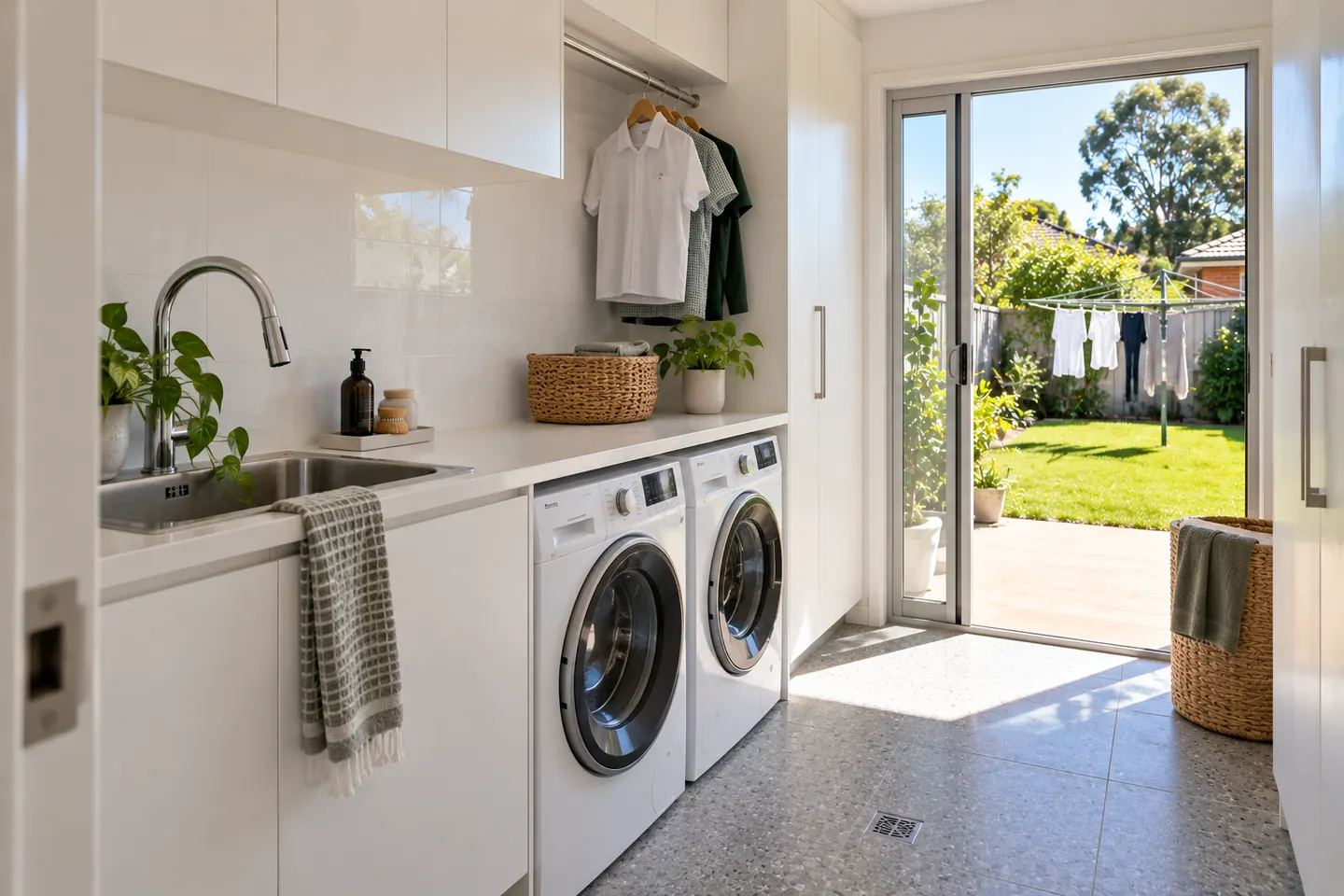
The typical Penrith laundry
In a 1970s or 1980s brick veneer home, the laundry is often:
- At the back of the house, opening onto the yard or the garage
- Fitted with a stainless steel tub on legs or in a basic cabinet
- Tiled on the floor, with a small splashback
- Missing a floor waste, or with one that is blocked or sits too high
- Short on storage, with the washing basket on the floor
In 1990s and 2000s homes it is usually an internal room or a cupboard off the hallway or garage, with a laminate bench and a gap for the washing machine.
What makes a laundry work
Bench space. Enough to fold a load of washing. Putting the machine under the bench, or stacking washer and dryer, gains the most.
Tall storage. A broom cupboard for the vacuum, mop and ironing board, and overhead cupboards to the ceiling.
A good tub. A deep stainless or composite tub set into the bench, with a pull-out mixer for rinsing muddy sports gear.
Hanging space. A rail for shirts and school uniforms, particularly useful in wet or very hot weather.
A floor waste. So a leaking hose does not end up in the hallway.
Ventilation. A laundry with a dryer running in summer gets hot and humid. An exhaust fan or an opening window matters.
Materials that suit a busy house
- Cabinets in moisture-resistant board with a laminate or two-pack finish
- Benchtops in laminate, compact laminate or porcelain. Engineered stone has been banned in Australia since 1 July 2024, so it is not an option.
- Floor tiles in porcelain with a slip-resistant finish
- Splashback tiled to the underside of the overhead cupboards
- Tapware that is easy to service, with quality cartridges
Laminate has improved enormously. For a laundry it is durable, easy to replace and far cheaper than stone-look alternatives.
Laundry and bathroom together
If the main bathroom is also due, doing both at once is one of the best-value decisions you can make. The trades, rubbish removal and waterproofing set-up are shared. The laundry usually adds $6,000 to $12,000 to a bathroom job instead of costing $9,000 or more on its own. See main bathroom renovations.
Moving the laundry
Sometimes it makes sense to move the laundry — into the garage, into a hallway cupboard, or out of a room that would be better as a pantry or study. It needs water, a waste and power, and a floor waste and membrane wherever the washing machine sits. On a slab, the waste route determines how easy that is.
Asbestos in older laundries
Laundries in pre-1990 Penrith homes can contain asbestos in wall sheeting, vinyl floors and the eaves just outside the door. They are tested before demolition, and any asbestos is removed by a licensed asbestos removalist.
Cost guide
| Laundry scope | Typical range |
|---|---|
| Cabinetry and benchtop refresh, tiles kept | $4,000 – $8,000 |
| Full laundry renovation | $9,000 – $18,000 |
| Laundry added to a bathroom renovation | adds about $6,000 – $12,000 |
A full laundry renovation usually takes one to two weeks. The cost page shows the bathroom bands for comparison.
Before you start
Decide whether you want the washer and dryer side by side or stacked. Measure your appliances. Choose cabinets and benchtops before demolition. The deposit on residential building work in NSW is capped at 10 per cent, and for work over $20,000 home building compensation cover must be in place before a deposit is requested.
Renovation work is carried out in partnership with Coastal Renovation Group, a licensed NSW builder; licence and insurance details are provided on request.
Call 02 4703 9332 or send the room details through.
Get a firm price
- PhotosTwo or three angles of the room.
- SizeRough length and width.
- Wish listShower, bath, vanity, storage.
Questions people ask before they commit
How much does a laundry renovation cost in Penrith?
As a 2026 guide, $9,000 to $18,000 for a typical laundry with new cabinetry, benchtop, tub, tiling and waterproofing. A simple cabinet-and-benchtop refresh with the existing tiles kept can be around $4,000 to $8,000.
Should the laundry be done with the bathroom?
If both are due, yes. The plumber, electrician, waterproofer and tiler are already booked, the skip is already there, and tiles can come in one order. The laundry typically adds less than it would cost on its own.
Can I stack the washer and dryer?
Yes, with a stacking kit or a tall cabinet designed for it. Stacking frees up bench space and is common in smaller laundries. Check the dryer's ventilation needs, or choose a heat-pump or condenser dryer.
Does a laundry need waterproofing?
Laundries are wet areas with waterproofing requirements, particularly around the tub and where there is a floor waste. A full floor membrane is sensible, especially if the laundry opens onto carpet or timber flooring.